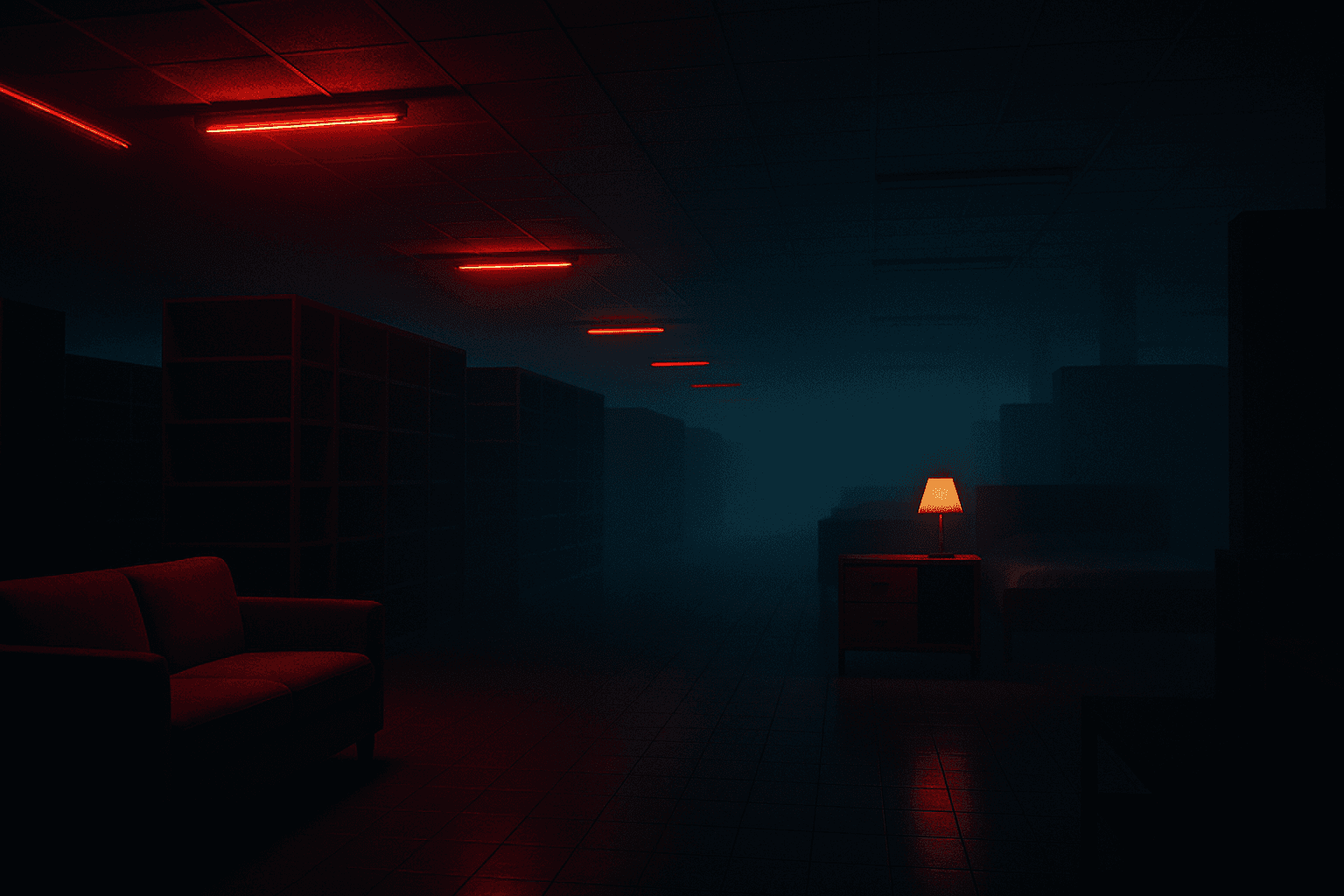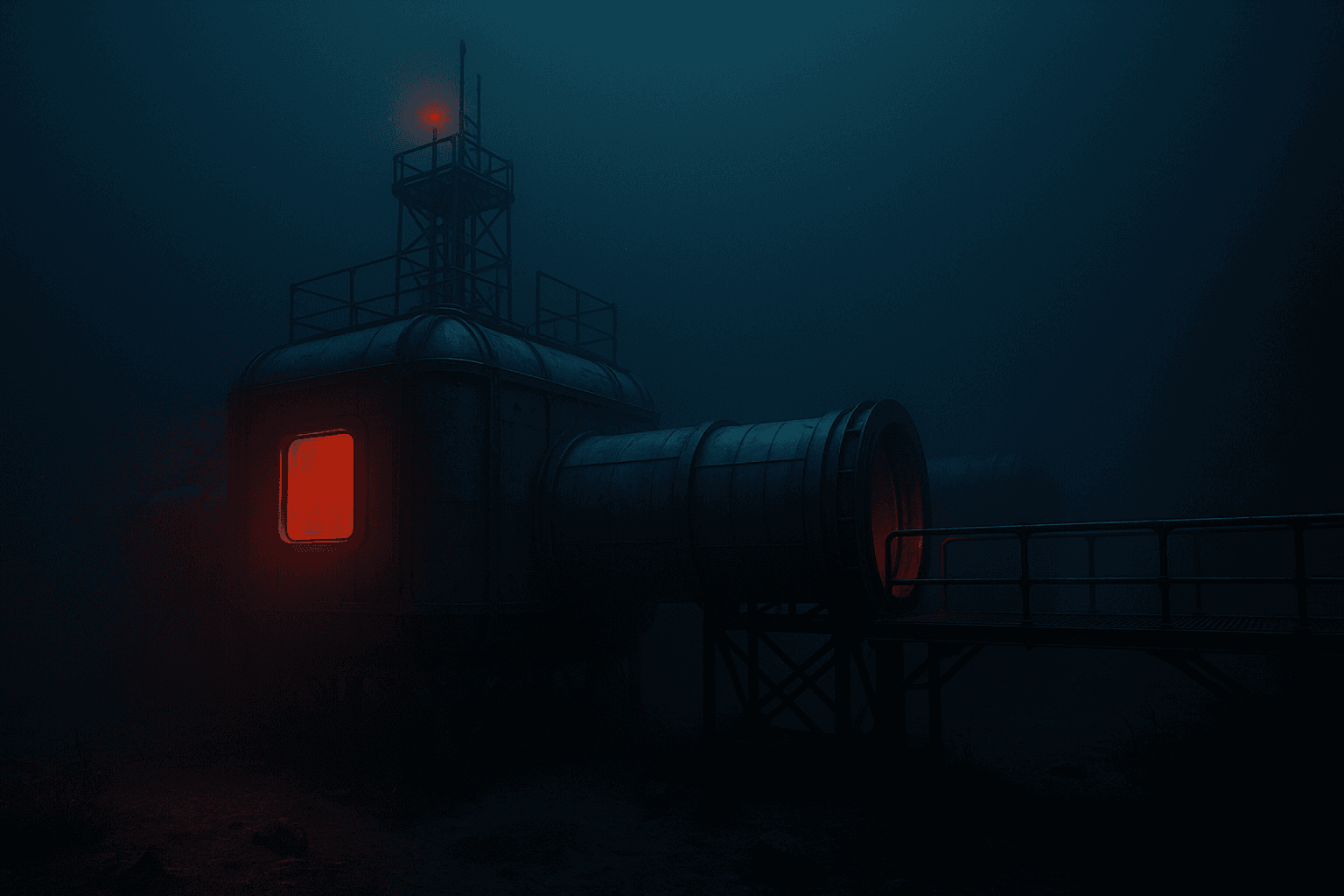
When Polaroid Studios released Apeirophobia on Roblox in 2022, the Backrooms were already one of the internet's most widely shared horror ideas — an endless maze of yellowed office space, humming fluorescent lights, and damp carpet. Apeirophobia took that creepypasta and built it into a level-by-level escape game, and players have been mapping its corridors ever since.
The title comes from the clinical term for a fear of infinity. That's a fitting name, because the game's real trick is making a finite map feel endless until you've memorized it — and then making you afraid of the moment your memory fails.
Apeirophobia is a Roblox horror game from Polaroid Studios set in the Backrooms. You escape a chain of numbered levels by finding exits and finishing objectives while entities hunt you by sight or sound.
What Is Apeirophobia?
At its core, Apeirophobia is a survival-escape game played solo or with a small group of friends. Each level is a self-contained space with its own layout, its own objective, and usually its own threat, and reaching the exit drops you into the next one.
There's no combat to speak of and no way to fight back. Your tools are your flashlight, your ears, your teammates, and — more than anything — your knowledge of where you're going.
The game has grown well past its launch roster, with community guides now counting more than a dozen levels and a dozen-odd entities. Keep in mind that counts vary between guides depending on when they were written, since Polaroid Studios has added levels in updates.
Where The Backrooms Idea Comes From
The Backrooms started as a single unsettling photo of an empty, yellow-walled room posted to an image board in 2019, paired with a short caption about "noclipping" out of reality. From there, the internet built out an entire mythology of numbered levels, each with its own rules and inhabitants.
That numbered-level structure is exactly what made the concept so easy to turn into a game. We cover the wider wave of Roblox games built on the same idea in our guide to Backrooms games on Roblox, and Apeirophobia is one of the best-known examples of the format.
What sets it apart is restraint. Rather than filling the Backrooms with constant jump scares, Apeirophobia lets the emptiness do most of the work, then introduces an entity only once you've started to feel safe.
How The Level Structure Works
Every level follows the same basic loop: arrive, orient yourself, find out what the level wants from you, and get out. Some levels just want you to find an exit, while others ask you to complete a task — turning valves, locating a code, or surviving a chase — before the way forward opens.
Here's how a typical run through a level breaks down:
- Orientation. You spawn with no map and no marker, so the first minute is spent reading the space. Landmarks matter far more than they do in most Roblox games.
- Objective discovery. The game rarely spells out the goal. Players learn objectives through trial, error, and the occasional community guide.
- Threat management. Each entity follows its own rules for detection and pursuit. Learning those rules is the difference between a clean clear and a restart.
- Exit. The way out is often deliberately easy to miss, such as a vent, a stairwell, or a door that blends into the walls around it.
All of this adds up to a game where your second attempt at a level feels completely different from your first. That shift — from lost to oriented — is the emotional engine of the whole experience.
Each Apeirophobia level has its own layout, objective, and entity. You find the exit or finish a task like turning valves to unlock it, and reaching it sends you into the next numbered level.
The Early Levels At A Glance
The first stretch of the game teaches you everything the later levels will test. Here's how the opening levels line up, based on the layouts and threats documented by community guides:
| Level | Name | Main threat | What it asks of you |
|---|---|---|---|
| 0 | The Lobby | Howler, Phantom Smiler | Find the vent and crawl through it |
| 1 | Poolrooms | Starfish, Phantom Smiler | Turn six valves to unlock the exit |
| 2 | Windows | None | Find the staircase down |
| 3 | Abandoned Office | Hound | Move quietly past a blind, sound-tracking hunter |
| 4 | Sewers | Varies by update | Navigate tight, repetitive tunnels |
| 5 | Cave System | Varies by update | Route through open, dark terrain |
Note that entity placements have shifted across updates, so treat the later rows as a general guide rather than a fixed rulebook. The first four levels, however, remain the best place to learn the game's language.
Level 0: The Lobby
The Lobby is the purest translation of the original Backrooms photo — mono-yellow walls, buzzing lights, and hallways that loop back on themselves. Your only job is to find a vent, but the Howler roams these halls, and a Phantom Smiler can blur your vision if you linger near it.
New players tend to wander. Experienced players walk a fixed route, and that difference is the first hint of what the game is really about.
Level 1: The Poolrooms
The Poolrooms swap carpet for white tile and shallow water, and the change in sound alone is enough to set you on edge. Your objective is to turn six valves scattered across the level, all while the Starfish patrols the water.
This is the first level where memorization pays off directly. Once you know where the valves are, the level shrinks from a sprawling labyrinth into a short, tense checklist.
Level 2: Windows
Windows has no entity at all, and that's precisely why it works. After two levels of being hunted, a quiet space with nothing chasing you is unsettling in its own right — you keep waiting for something that never arrives.
Level 3: The Abandoned Office
The Hound is blind, but it reacts to even the slightest sound. That single rule changes how you move, how you talk to your teammates, and how fast you're willing to go.
In other words, the Abandoned Office punishes panic. Players who know the layout can afford to walk slowly, while players who don't are tempted to sprint — and sprinting is exactly what gets them caught.
Why Memorization Turns Into Dread
Most horror games lose their bite on a second playthrough, because once you know where the scares are, they stop being scary. Apeirophobia flips that relationship by making the map itself the thing you have to master — and mastery comes with its own kind of fear.
We dig into this design pattern across the genre in our breakdown of how Roblox horror games build fear. Apeirophobia is one of the clearest examples of it on the platform.
Apeirophobia makes you memorize repetitive, near-identical layouts to survive. Once you rely on that memory, every wrong turn feels catastrophic, so the fear shifts from the monster to your own mistakes.
The Map Is The Monster
The Backrooms are built from repetition: the same wallpaper, the same lights, the same doorways, over and over. That sameness makes landmarks scarce, so the few you do learn — a pillar, a stain, a bend in the hall — become precious.
As a result, your mental map is the most valuable thing you carry. When that map turns out to be wrong, even by one corner, the game's emptiness snaps back into focus, and the infinity in the title stops feeling like a metaphor.
Sound As Both Tool And Threat
Apeirophobia leans heavily on audio, from the hum of the Lobby lights to the slosh of the Poolrooms. Footsteps, distant noises, and entity cues tell you where danger is long before you see it.
Of course, the same audio cuts both ways. In the Abandoned Office, your own noise is the threat, so the game teaches you to listen carefully and then forces you to stay silent while you do.
Quiet Levels That Do Real Work
Levels like Windows prove that the absence of a threat can be as stressful as its presence. After learning to expect an entity on every floor, an empty level leaves you bracing for a scare that doesn't come.
This pacing matters because it keeps players from settling into a routine. Just when the loop of learn-route-escape starts to feel mechanical, the game changes the rhythm.
Names That Set The Tone
Even the level names play into the dread. Later floors carry titles like "!!!!!!!!!" and "The End?" — the first a wordless warning, the second a question the game has no intention of answering kindly.
The Entities And How They Hunt
Apeirophobia's entities are less about gore and more about rules. Each one teaches a specific survival behavior, and the game layers those behaviors on top of each other as you go deeper.
Some of the most important entities include but are not limited to:
- Howler. The roaming threat of the Lobby, it teaches you to keep moving with purpose instead of wandering. Getting lost near it is how most first runs end.
- Phantom Smiler. A grinning presence that blurs your screen when you get close. It shows up across several levels, punishing players who stop to stare.
- Starfish. The Poolrooms' water-bound hunter, it turns a valve-collecting task into a tense route-planning exercise.
- Hound. Blind but acutely sensitive to sound, the Hound forces slow, deliberate movement and silent teamwork.
- Titan Smiler. A larger and more aggressive Smiler variant, it appears in deeper levels — Level 10 reportedly features two of them alongside a Phantom Smiler.
- Skin Stealer. One of the later-game threats, encountered once the levels have stopped resembling the original Backrooms photo.
Overall, none of these entities can be fought, only understood. That's why the game rewards knowledge so heavily — and why forgetting a rule feels so punishing.
Entities in Apeirophobia can't be fought, only avoided. Each follows its own rule — the Hound tracks sound, the Phantom Smiler blurs your screen — so survival depends on learning those rules level by level.
Playing Apeirophobia With A Group
Apeirophobia is playable solo, but it was clearly designed with groups in mind. A party can split the work of a level, with one player scouting the route, another tracking objectives, and the rest watching for entities.
That said, groups bring their own problems. Voice chat and running footsteps are noise, and in sound-sensitive levels like the Abandoned Office, a single excited teammate can bring the Hound down on everyone.
Here's a simple role split that tends to work well for parties of three or four:
- Navigator. The player who knows the level best leads the route and calls landmarks. Everyone else follows instead of exploring on their own.
- Objective runner. On task-based levels like the Poolrooms, one player focuses on valves or codes while the navigator keeps the group oriented.
- Rear watch. One player trails the group and calls out entity cues. This role matters most on levels where threats approach from behind.
If you're looking for more games that reward this kind of coordination, our list of the best co-op horror games on Roblox covers several that pair well with Apeirophobia.
Apeirophobia can be played solo, but groups clear levels faster by splitting roles. Assign a navigator, an objective runner, and a rear watch, and keep quiet on sound-sensitive levels like the Abandoned Office.
How Apeirophobia Compares To Pressure, 3008, And The Mimic
Apeirophobia sits in a run of single-game horror features on Endsights, alongside Pressure, 3008, and The Mimic. Each of those games builds dread in a different way, and putting them side by side shows what makes Apeirophobia distinct.
| Game | Setting | Core fear | Progression |
|---|---|---|---|
| Apeirophobia | The Backrooms | Getting lost in endless repetition | Numbered levels with distinct objectives |
| Pressure | Deep-sea research facility | Unseen threats in flooding corridors | Room-by-room descent |
| 3008 | An infinite furniture store | Surviving the night against hostile staff | Open-ended day/night survival |
| The Mimic | Japanese folklore settings | Story-driven encounters and chases | Chapter-based narrative |
3008 is the closest cousin, since it also builds on an infinite-space creepypasta. However, 3008 is a sandbox you survive night after night, while Apeirophobia is a linear gauntlet you learn and conquer.
The Mimic, by contrast, leans on story and cultural horror, and Pressure leans on claustrophobia and audio cues in a cramped facility. Apeirophobia is the purest of the four in one respect — its horror comes from space itself.
Is Apeirophobia Still Worth Playing In 2026?
Apeirophobia is no longer the new arrival it was in 2022, and Roblox horror has grown far more crowded since. Even so, its core idea has aged well, because a maze that rewards memory never really goes out of style.
It's especially worth playing if you like slow-burn tension over constant jump scares, or if you enjoy learning a game well enough to guide friends through it. Players who want story, lore, or combat will likely be happier elsewhere.
Apeirophobia is still worth playing in 2026 if you like slow-burn tension and route mastery. Players who want story, lore, or combat may prefer The Mimic or other narrative-driven Roblox horror games.
If you're not sure where it fits in your rotation, our ranking of the best horror games on Roblox puts it in context with everything else on the platform. Start there, then take a friend into the Lobby — and remember the way out.
Frequently Asked Questions
Who made Apeirophobia on Roblox?
Apeirophobia was developed by Polaroid Studios and released on Roblox in 2022. The studio has expanded it with new levels and entities in updates since launch.
Is Apeirophobia scary for younger players?
Apeirophobia relies on atmosphere, chases, and sudden entity encounters rather than gore. That said, the tension is sustained, so parents may want to try a level first before deciding.
What is the hardest early level in Apeirophobia?
Many players struggle most with Level 3, the Abandoned Office. The blind Hound reacts to any sound, so panicked sprinting or loud voice chat often ends the run.
Does Apeirophobia follow the original Backrooms lore?
It borrows the Backrooms' core imagery and numbered-level idea, but its levels, objectives, and entities are its own. Treat it as an adaptation rather than a faithful retelling.
Can you fight entities in Apeirophobia?
No. Apeirophobia has no combat, so every entity must be avoided by learning its detection rules, moving carefully, and knowing the route to the exit.