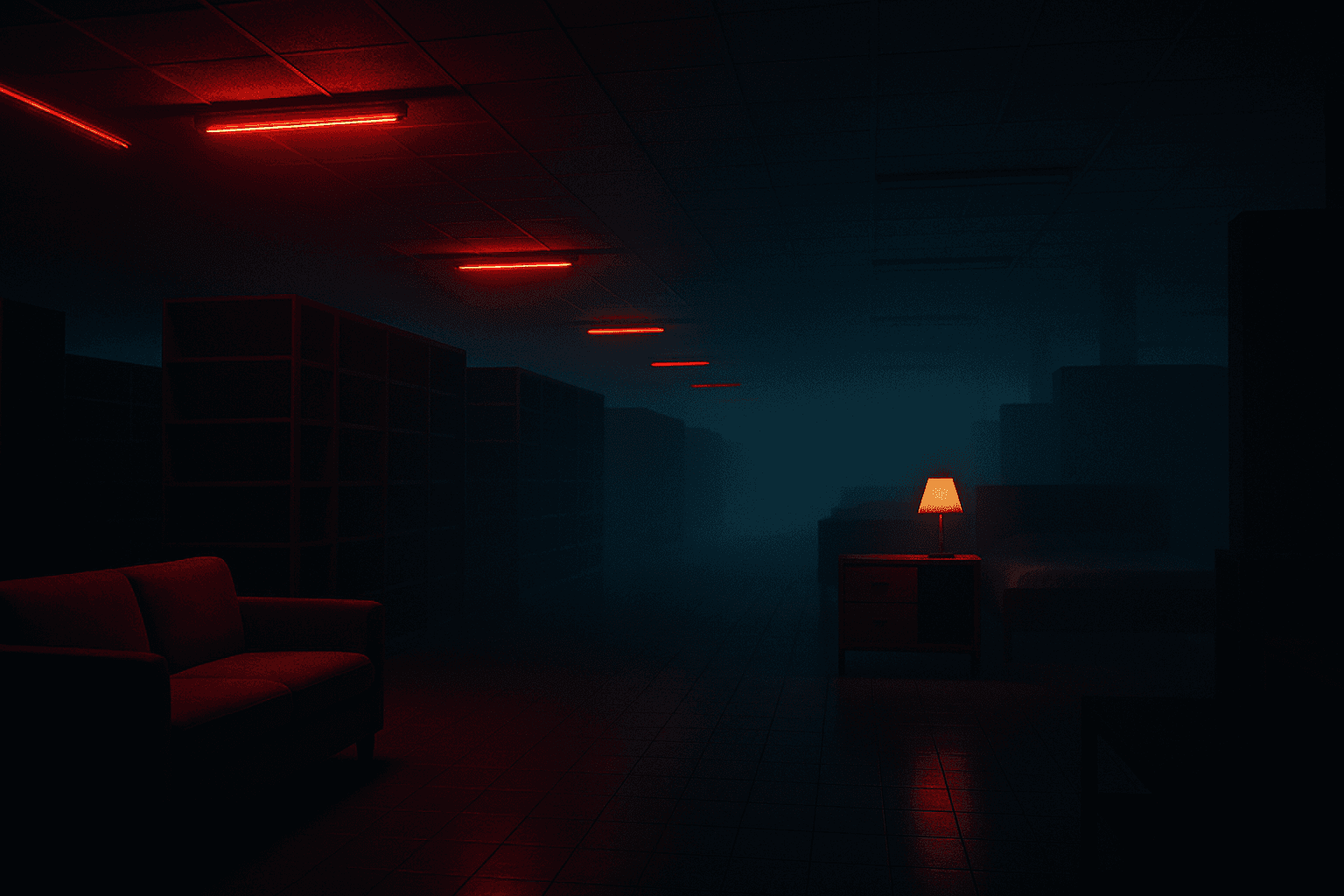
In 2022, a strange new kind of clip started flooding YouTube and TikTok. In each one, a player sprints down an endless backrooms-style hallway while a flat, grinning photograph slides after them, blaring distorted music.
Those chasers came from Garry's Mod, where modders had started calling them "nextbots." Within months, Roblox had its own version of the craze, and Evade, from the Hexagon Development Community, became the game that defined it.
Years later, Evade is still the reference point that every newer nextbot game gets measured against. It's worth understanding why a picture that follows you around can be one of the most effective fear mechanics on the platform.
Our horror deep-dive series has already covered Doors: Floor Two, The Rake, Piggy, and Forsaken. Evade fills the one gap left, and it does so with less than any of them — no story, no lore, and enemies that don't even have a body.
Evade is a Hexagon Development Community chase game where players outrun nextbots — flat meme images that pursue at speed — and revive downed teammates to survive each round.
What Is Evade?
Evade is a round-based survival game in which a group of players spawns into a map alongside one or more nextbots. The goal is simple — stay alive until the round timer runs out, and pull teammates back up when they go down.
Survive each round by outrunning the nextbots until the timer ends. If you're caught, you go down, and a teammate has to reach you and revive you before you're out.
When a nextbot touches you, you're downed rather than eliminated outright. A teammate can revive you if they reach you in time, which means every rescue is a gamble between helping the team and becoming the next target.
Rounds rotate through a wide variety of maps, from cramped interiors to sprawling outdoor spaces. Each one changes the chase, since tight corridors favor quick turns while open ground favors raw speed.
Keep in mind that there's no weapon to pick up and no door to lock behind you. Your only real tools are your legs, your read on the map, and whatever movement tricks you've picked up along the way.
Where Did Nextbots Come From?
The word has a surprisingly technical origin. NextBot is the name of Valve's AI framework for non-player characters, used in games like Left 4 Dead and Team Fortress 2, and Garry's Mod exposes that same system to its modders.
The name comes from NextBot, Valve's NPC AI framework used in Left 4 Dead and exposed in Garry's Mod. Modders attached flat images to it, and the name stuck to the chasers themselves.
Garry's Mod creators figured out that they could attach a single flat image to a NextBot, give it a looping sound, and set it loose on a map. The results — distorted faces, meme photos, cursed stock images — chased players through liminal spaces like backrooms mazes and empty office floors.
That said, the name quickly drifted from the engine to the creature. By the time the format jumped to Roblox, "nextbot" simply meant a flat image that hunts you, and Evade adopted that shorthand wholesale.
Why Does A Flat Image Work As A Horror Monster?
Most horror monsters are built to look real, with detailed models, animated limbs, and careful lighting. Nextbots skip all of that, and the omission turns out to be exactly what makes them work.
Nextbots always face you, give no body-language tells, and announce themselves with looping audio that grows louder as they close in. The fear comes from pursuit rather than the image itself.
It Always Faces You
A nextbot is rendered as a billboard sprite, which means the image rotates to face the camera no matter where you stand. There is no angle from which you can catch it looking away, and no profile view that exposes it as a flat cutout.
As a result, your brain never gets the reassurance of seeing the back of the monster. It is always staring, always oriented toward you, and always closing distance.
It Gives Away Nothing
An animated monster telegraphs its intentions through body language — a crouch before a lunge, a head turn before a charge. A nextbot has no body, so it offers no tells at all.
Moreover, the faces themselves are frozen mid-expression. A wide grin or a blank stare that never changes becomes deeply unsettling once it's gliding toward you faster than you'd like.
It Sits In The Uncanny Valley
Many nextbot images are real photographs or near-photographic edits placed inside a blocky, low-poly world. That mismatch between a realistic face and a cartoonish environment produces a steady, low-grade wrongness — the same effect that drives much of mascot horror.
Why Is The Sound So Important?
If you play Evade on mute, the game loses much of its fear. Each nextbot carries its own looping audio track — often a distorted song clip, a scream, or a blown-out meme sound — and that track plays from the nextbot's position in the world.
In practice, this means you hear a nextbot long before you see it. The volume swells as it closes in, which turns sound into a proximity meter that your body reacts to before your eyes can confirm anything.
What's more, the audio is often absurd on its own terms. A song that would be funny in a meme becomes something else entirely when it's getting louder behind you in a dark corridor, and that tonal whiplash is a big part of why the format spread so quickly.
Design note: Audio-as-radar is one of the oldest tricks in horror, and Evade strips away almost everything else, so the sound cue carries more weight than it would in a game where visuals do the heavy lifting. We break down the wider technique in our guide to horror game design.
Why Do Nextbots Feel Relentless?
Fear in a chase game depends on the chaser never letting up. Nextbots don't get tired, don't stop to search rooms, and don't lose interest — they path toward a target and keep coming.
This is why Evade feels so different from hide-and-seek horror. In Doors, a closet can save you from Rush; in Evade, there's rarely anywhere a nextbot can't reach, so escape comes from distance rather than concealment.
Of course, the design isn't unfair. Nextbots have to follow the map's walkable routes, so smart players use corners, stairs, and tight turns to force them onto longer paths while the team buys time.
How Does Movement Keep You Alive?
Since you can't fight back and can rarely hide, movement becomes the entire skill ceiling. New players sprint in straight lines and get caught, while experienced players chain jumps, slides, and turns to keep their speed up and their options open.
Evade is easy to learn but has a high movement skill ceiling. Chaining jumps and slides to keep momentum, plus learning each map's loops, is what separates veterans from new players.
Here's how movement typically separates a survivor from a spectator:
- Momentum. Chained jumps and slides help you carry speed through a route instead of bleeding it at every corner. Players who master this can outpace the pressure on open ground.
- Route knowledge. Every map has loops, ledges, and chokepoints. Knowing where a nextbot will be forced onto a longer path is often worth more than raw speed.
- Kiting. Drawing a nextbot around in a wide circle keeps it away from downed teammates. It's the most selfless play in the game, and it's often what turns a losing round around.
- Vertical escapes. Rooftops, stairwells, and raised platforms can buy precious seconds. Be aware that a high ledge with only one way down can quickly become a trap.
All of these reward practice, and that's a big reason Evade has held onto players long after the meme wave faded. The horror hooks you first; the movement keeps you around.
How Does The Revive Mechanic Build Tension?
Without teammates, Evade would be a pure reflex test. The downed-and-revive system turns it into a social pressure cooker, because every downed teammate is a decision you have to make in real time.
Going back for someone means running toward the danger rather than away from it. Leaving them means the team loses a runner who could have drawn attention away from you later in the round.
Naturally, these moments generate the stories players remember — the last-second revive, the rescue that got two people caught, the teammate who kited a nextbot away to buy you a clean pickup. That cooperative panic is the same ingredient that makes the best Roblox survival games so replayable.
Why Is Evade Funny And Scary At The Same Time?
Evade lives on a knife's edge between comedy and dread. The images are memes, the audio is often a joke, and yet players still yelp when one rounds the corner.
This works because the two reactions sit so close together. A jolt of fear followed by the realization that the thing chasing you is a ridiculous picture produces a spike of adrenaline and then relief, and that cycle is addictive in a way that slow, heavy dread rarely is.
In addition, the comedy lowers the barrier to entry. Players who would never touch a slow-burn psychological horror game will happily jump into Evade with friends, which is exactly how it reached such a broad audience.
How Does Evade Compare To Other Roblox Horror Games?
Each of the major horror games in our series builds fear from a different source. The table below compares Evade with the others we've covered, based on how each game threatens you and how you respond.
| Game | Threat | Your Defense | Primary Fear Source |
|---|---|---|---|
| Evade | Flat nextbot images that chase without stopping | Movement, map knowledge, reviving teammates | Proximity audio and pursuit |
| Doors | Entities roaming a procedurally generated hotel | Hiding, listening, reading room cues | Anticipation and surprise |
| The Rake | A single creature hunting through the night | Staying together, avoiding its path | Darkness and vulnerability |
| Piggy | A pursuer stalking you while you solve escape puzzles | Item puzzles and evasion | Being hunted while distracted |
| Forsaken | Player-controlled killers in asymmetric rounds | Survivor abilities and teamwork | A human opponent who adapts |
Overall, Evade is the most stripped-down of the group. It has the least story, the simplest threat, and the purest reliance on movement — which is exactly why it remains the benchmark for chase horror specifically.
If you want the full field ranked from best to worst, see our ranking of the best horror Roblox games. Evade earns its place there on execution rather than ambition.
Tips For Surviving Your First Rounds In Evade
If you're just starting out, a few habits will keep you alive noticeably longer. Here's a list of the fundamentals that matter most:
- Play with sound on. Audio is your earliest warning. Headphones help you tell which direction a nextbot is coming from, not just that it's near.
- Never run into a dead end. Before you commit to a hallway or room, make sure it has a second exit. Nextbots punish tunnel vision immediately.
- Watch the veterans. Spectating after you go down is a free lesson. Pay attention to the routes experienced players take and how they handle corners.
- Revive with a plan. Check where the nextbots are before you commit to a rescue. A revive that gets you both downed helps no one.
- Stay near the group, not on top of it. Spreading out slightly means one nextbot can't sweep up the whole team. Clustering too tightly turns one mistake into a wipe.
Remember that everyone gets caught early on. Survival in Evade is a skill you build round by round, and your first few dozen downs are simply part of the learning curve.
Why Evade Still Defines The Nextbot Format
Plenty of Roblox games have borrowed the nextbot idea since 2022, including Nico's Nextbots and a long tail of smaller imitators. Most of them copy the surface — flat images, loud audio — without the movement depth or cooperative structure that make Evade hold up over hundreds of rounds.
The nextbot format started in Garry's Mod. Evade brought it to Roblox in 2022 and became the version most players now associate with the genre.
Evade got the fundamentals right early: a threat that never stops, a warning system built from sound, a skill ceiling built from movement, and a revive loop that forces players to care about each other. That combination is why it has stayed the reference point, and why flat images that pursue you remain one of the most efficient fear mechanics Roblox has produced.
For a look at the newer horror projects trying to push the genre forward, keep an eye on our indie horror tracker. The next great chase game will almost certainly borrow something from Evade.
Frequently Asked Questions About Evade
Here are answers to the questions new players ask most often about Evade and its nextbots.
Can you hide from nextbots in Evade?
Not reliably. Evade's maps favor open routes, and nextbots path straight to you, so movement — jumping, sliding, and keeping momentum — keeps you alive far better than any hiding spot.
What happens when a nextbot catches you in Evade?
You go down rather than dying outright. A teammate can revive you if they reach you in time; otherwise you sit out and wait for the next round to begin.
Do you need Robux to enjoy Evade?
No. The core loop of surviving rounds, reviving teammates, and learning maps is free to play, and the movement skill that matters most is something you practice rather than buy.
Is Evade too scary for younger players?
It leans more toward startle-and-laugh than dread. The loud audio and sudden chases can jolt you, but there's no gore, so players comfortable with Piggy or Doors will usually handle it fine.
Is Evade still worth playing in 2026?
Yes, if you want movement-driven horror. It remains the reference point for nextbot games, and its skill ceiling in chaining jumps and slides keeps experienced players coming back.